
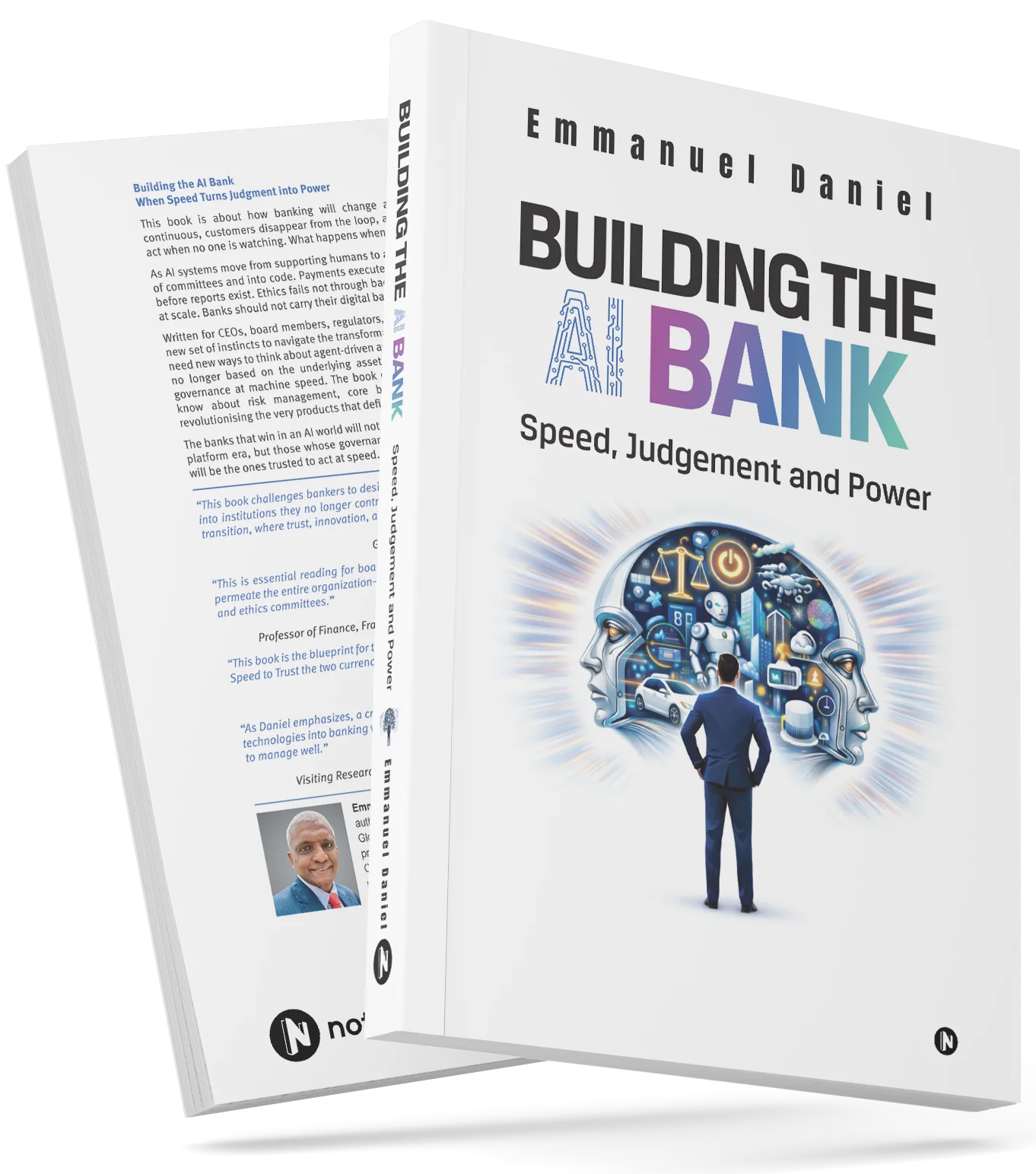
Building the AI Bank
When Speed Defines the Rules
This book is not about artificial intelligence as a tool, a software upgrade, or the next productivity wave in banking. It is about the evolution of a whole new ecosystem where speed, the network effect and the lack of control over processes in AI will shape the future of banking.
Who gets access. On what terms. At what price. And with what consequences. For most of modern financial history, the power in banking was exercised by people through institutions, laws, and balance sheets. Judgement was human. Accountability was personal. Failure had a face.
The AI era breaks that continuity. Artificial intelligence does not merely execute instructions — it infers, predicts, and adapts. Once judgement is delegated, even partially, the institution itself changes character. A bank stops being a collection of people supported by machines. It becomes a machine-supported intelligence that employs people.





Table of contents
Table of Contents
Preface
Forewords7
Preface: When speed defines the rules9
Chapter 1. The World after Digital Banks12
- From Digital to Delegation12
- From Platforms to Agents13
- Generative AI and the Customer’s Narrative14
- Web3 Is Not Web 3.015
- Why AI, CeFi, DeFi, and TradFi Must Be Read Together16
Chapter 2. Where Is AI Taking Us?19
- Decentralising Intelligence20
- When the User Defines the Context20
- The Shift from Language to Action21
- Ambient Finance and the End of the Device22
- Navigating the Path of Least Resistance23
Chapter 3. Building the AI Operating Model25
- Who owns the decisions?26
- Measuring the right matrix27
- A Note to Digital-Only Banks27
- Execution Beyond the Institution28
Chapter 4. The Balance Sheet Comes to Life31
- AI as a Balance-Sheet Amplifier32
- Treasury in a Game of Thrones32
- When Treasury Goes Real-Time35
- The Retail–Treasury FTP Tension35
- Digital Assets on the Balance Sheet36
- Programmable Liabilities and Active Stability37
- US State Banks Already Living This37
Chapter 5. Payments as AI in Motion39
- From Messaging to Execution39
- Cross-Border CBDC Pilots40
- Permissioned versus permissionless43
- Payments in an Agent-Mediated World44
- The legacy card players45
- PayPal and Stripe: Two Diverging AI Futures45
- Can India’s UPI scale intelligence?46
- China: The state versus agentic AI tension46
- M-Pesa: From Mobile Money to AI Infrastructure48
Chapter 6. AI as an Operating System49
- The Real AI Stack of a Bank49
- Models Do Not Create Power52
- Execution: Where Payments Change Everything53
- The Data Outside the Bank53
- Why Ring-Fencing Fails in an AI World54
- Trust Becomes Machine-Readable55
Chapter 7. New Products for a New Age57
- Ghosts from A Digital Past57
- Digital Assets Are Not Products Either60
- “The Conversation is the Product”60
- Reddit and the Pre-Product Signal61
- Products as life management62
- Products Ruled by Permissions63
- The Product Strategy of the AI Bank64
Chapter 8. Agents from Apps to Actors66
- From Tools to Actors66
- Generative AI and Agents Feed Each Other68
- Agents Inside Financial Institutions Today68
- Outside Banking, the Pattern Is Clear69
- Customers Are Building Agents Too69
- The Balance-Sheet Consequence70
- From APIs to Execution Partners71
- Agents Redefine Organisational Boundaries71
- Can AI Agents Become an AI Bank?72
Chapter 9. Risk, Regulation and Networked Belief74
- Risk was Labour Intensive74
- From Risk as Exposure to Risk as Behaviour75
- From Basel I to Basel III: Risk as Position76
- Basel V: Risk as Behaviour in Motion77
- The CRO’s roles are already changing79
- Manufactured Belief as a New Risk80
- Human Discretion Repositioned81
- Financial Inclusion and Network Risk81
- Risk as Legitimacy in the AI Bank82
Chapter 10. Cybersecurity in the Age of Intelligence84
- When Identity Collapses84
- Cyber Is No Longer a Perimeter85
- Zero Trust Architecture Meets Reality85
- Vendor Concentration86
- Protocol Risk Becomes Operational Risk86
- From Preventing Fraud to Surviving Deception87
- Cybersecurity as a Learning System87
- What AI Banks Must Do Differently88
Chapter 11. Ethics Is In The Plumbing90
- From Principles to Power90
- Bias and Discrimination91
- Explainability Is a Moral Boundary91
- Surveillance, Privacy and Consent Are Design Questions92
- Automation Bias and Abdicated Responsibility92
- Manipulation and Behaviour Steering93
- Unequal Error Distribution Reveals Who Ethics Serves93
- Speed Without Due Process Is the New Ethical Failure Mode93
- Model Bias, Drift, and Silent Value Change94
- Ethics as Infrastructure94
Chapter 12. Leadership When Machines Decide96
- When Leadership Becomes Explicit96
- What Boards Are Really Asking97
- The First Reframe: AI Is Not a Project Line Item97
- Should We Abandon Digital Banking?98
- Leadership Roles Under Pressure98
- The Second Reframe: Invest in Decision Surfaces, Not Scale99
- A Board Heuristic for the AI Bank100
- The Final Reframe: AI Spend Is a Statement of Intent100
Chapter 13. Conclusion: A First Day at an AI Bank (2030)102
Glossary105
































Leave a Comment