

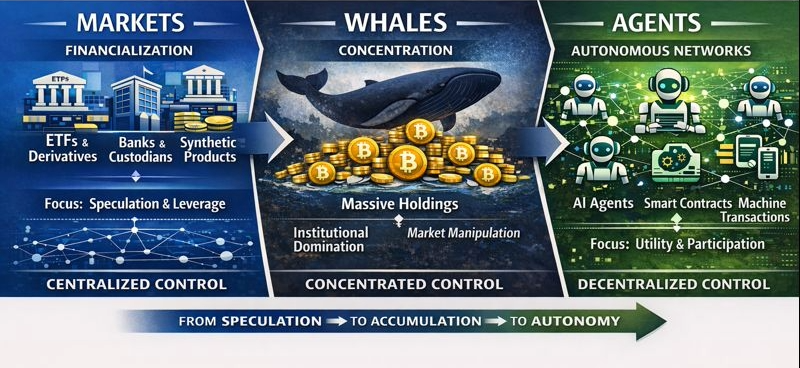
When I first wrote The Great Transition – the Personalisation of Finance Is Here, the argument was simple but radical: finance was moving away from institutions and toward individuals, away from products and toward experiences, away from static balance sheets and toward dynamic networks.

Money was supposed to become personal, contextual, programmable, and embedded.
Digital assets were meant to be enablers.
They offered the missing layer finance had never possessed: a native, digital way to represent value, ownership, identity, and rules in the same system. In theory, this would allow finance to reorganise itself around people, communities, machines, and networks rather than banks, intermediaries, and centralised platforms.
And yet today on the last days of 2025, that transition appears to have stalled.
But digital assets did not disappear. Adoption did not collapse. Market capitalisation did not evaporate. Instead, something subtler happened. Finance did not decentralise. It financialised.
Between 2023 and 2025, the global banks did something extraordinary: they tamed crypto and reconstructed its narrative into their own image.
By early 2025:
- Global crypto ETFs and ETPs exceeded $120–150 billion in assets under management.
- This happened faster than gold ETFs, which took nearly a decade after 2004 to reach similar scale.
- Spot Bitcoin ETFs in the US alone accumulated $60–80 billion in under 18 months, one of the fastest ETF adoption curves in financial history.
To put this into context:
- Early gold ETFs reshaped gold markets over 10–15 years.
- Crypto ETFs reshaped crypto ownership in less than two.
Meanwhile:
- Open interest in Bitcoin and Ethereum futures on CME Group regularly exceeded $25–30 billion, comparable to mid-sized equity index derivatives.
- Offshore perpetual markets often doubled or tripled that exposure.
- Investment banks created billions of dollars of structured inprincipal-protected notes, yield notes, and volatility-linked products referencing crypto.
Crypto was financialised on an industrial scale.
And critically, none of these exposures require ownership of the actual underlying asset or participation in the networked economy it was supposed to create.
Markets at the expense of Networks
A networked economy depends on participation:
- Facebook reached billions of users before it became a financial asset.
- The internet reached global utility before it became a tradable narrative.
- But crypto became a trillion-dollar market before it became a trillion-dollar network.
For the first time in history, a technology became a trillion-dollar market before becoming a trillion-dollar platform.
You do not merely invest in a network. You use it. You stake it. You govern it. You build on it. You integrate it into payments, logistics, identity, data sharing, and coordination.
The financialisation of digital assets has enabled millions of participants to gain exposure but without participation. This has created a paradox: digital assets have never been more widely owned, yet their network effects have grown more slowly than their market capitalisation.
This inversion matters.
- ETF holders do not need wallets.
- Futures traders do not deploy smart contracts.
- Derivatives traders do not need nodes.
- Structured product buyers do not build applications.
- Structured product investors do not vote in protocol governance.
- Capital circulates, prices move, but the underlying networks remain underutilised relative to their theoretical potential.
This created a paradox:
- Crypto ownership became widespread, but.
- Crypto usage remained narrow.
Markets flourished. Networks stagnated.
Crypto is being financialised before it can be democratised.
Despite extraordinary market capitalisation, real economic integration of crypto into trade, supply chains, identity systems, and enterprise workflows lag expectations and in most cases, are not even discussed.
We don’t pay attention to what’s happening in Github as a purveyor of what will be happening next.
The difference between Networks and Markets
Markets are not networks and networks are not markets. They are fundamentally different organising principles.
In my book, I borrowed a concept from the RAND analyst David Rondfeldt, that society evolved from tribes to institutions and then into markets and finally into networks.
Tribal – ethnic, linguistic and geographic concentration.
Institutional – institutions that enable tribes to relate to each other through education, religion, shared experiences and beliefs reinforced in institutions.
Markets – where communities can transact across geographies based on extractive supply and demand, Willing buyer, willing seller through a price discovery process.
Markets exist to:
- Discover prices
- Allocate capital
- Transfer risk
- Monetise volatility
They reward:
- Intermediation
- Scale
- Leverage
- Liquidity
Networks – are all about connectivity, the untiring building of utilities, and being generative, creating new meanings, new associations.
Networks exist to:
- Coordinate activity
- Share information
- Enable participation
- Compound utility
They reward:
- Adoption
- Contribution
- Trust
- Interoperability
We are so not there.
Digital assets were born to define the networked economy. Bitcoin was not designed as an investment product; it was designed as a peer-to-peer value network. Ethereum was conceived not as a trading venue but as a general-purpose coordination layer for programmable economic activity.
But markets do not care at all about the intent for which they were created. Capital markets require digital assets to be liquid, volatile, and globally accessible to exchanges, brokers, prime desks, custodians, derivatives structurers, asset managers, and private banks. Not through wallets, protocols, or decentralised applications.
Tokens were meant to align incentives across participants, not to become speculative instruments in isolation. But markets do not care about the origin story.
Whales – The New Market Sovereigns
Overlaying this financialisation was a second force: concentration.
By 2025:
- Less than 2 percent of Bitcoin addresses controlled over 60 percent of circulating supply.
- Ethereum showed similar, though slightly less extreme, patterns.
But the identity of whales had changed.
They were no longer just early adopters. They were:
- Corporates
- Asset managers
- Custodians
- ETFs
- Treasury vehicles
Microstrategy (now called Strategy, MSTR) as a Sovereign-Scale Whale
Strategy controlled over 3 percent of all Bitcoin in circulation by 2025.
To put that in perspective:
- No single corporate entity controls even 1 percent of global gold supply.
- No sovereign owns more than 1.5 percent of global equities. Norway’s sovereign wealth fund (Norges Bank Investment Management) does hold roughly 1.5 percent of all listed company equity worldwide, but it is so thinned out that it is not a market maker in any way.
- Strategy’s Bitcoin position is closer in proportional scale to a central bank reserve than a corporate treasury.
Ethereum and the Institutional Accumulation Thesis
In Ethereum, the conversation in 2025 shifted from usage to strategic ownership thanks mostly to Tom Lee.
Tom Lee publicly declared that his Bitmine Immersion Technology (BMNR) should aim to own 2–3 percent of Ethereum supply as a long-term position.
If adopted by even a handful of large asset managers, this logic would turn Ethereum into a thinly held strategic asset, not a broadly owned coordination network.
Despite their ardent belief in the underlying technology of their assets, at this point in their accumulation, whales do not need networks or functionalities. They need:
- Liquidity
- Volatility
- Leverage
In fact, deep network utility dampens market volatility. Stability compresses trading margins.
For the whales to accumulate, the ideal crypto ecosystem has to be one that is:
- Highly liquid
- Permanently tradable
- Narrative-driven
- Only partially utilised
Markets reward this. Networks do not.
As a result, the gravitational pull of whales is further pulling crypto toward market dominance and still expect that personal, participatory finance is just around the corner. Something must give.
The personalised of finance depends on:
- Direct ownership
- Contextual usage
- Embedded value flows
- User-level agency
But financialisation replaced:
- Users with investors
- Agency with exposure
- Participation with observation
Instead of millions of individuals using networks to personalise finance, value pooled into:
- ETFs
- Custodians
- Treasury vehicles
- Structured products
Finance today is scaled up, not out.
AI Agents as the Next Ownership Class
And this is where the next phase begins.
The great transition has not failed as yet. It simply lacks the right economic actor.
Humans are poor network participants at scale. We do not rebalance continuously. We do not manage micro-positions efficiently. We do not coordinate across thousands of protocols.
Markets are better at this than people. Whales are better than markets. But AI agents will be better than whales can ever hope to be.
AI agents introduce something entirely new into finance:
- Continuous participation
- Autonomous decision-making
- Micro-ownership
- Utility-driven behaviour
Unlike whales, AI agents:
- Optimise for function, not volatility
- Require networks to operate
- Depend on programmable money
- Transact natively, not synthetically
An AI agent does not want ETF exposure. It wants settlement certainty.
It does not speculate. It executes tasks.
It does not hold assets for prestige.
It holds assets for utility.
AI agents will:
- Pay other agents
- Settle instantly
- Rebalance autonomously
- Use digital assets as fuel, not trophies
It is this that will reintroduces personalisation, but at machine scale.
We are now entering a bifurcation.
Possible Future One: Whale-Dominated Markets
- Concentrated ownership
- Synthetic exposure
- Permanent volatility
- Finance as spectacle
Possible Future Two: Agent-Driven Networks
- Distributed ownership
- Embedded utility
- Continuous settlement
- Finance as infrastructure
The first future enriches intermediaries. The second reshapes society. It is understandable that the incumbent markets tried to tame digital assets into becoming a financial asset. Finance participants did what they knew how to do.
AI agents did not exist until now. Technology is about to force the second option open.
A small shift will be that the personalisation of finance will not end with individuals being empowered. It will evolve toward intelligent agents acting on behalf of individuals, institutions and systems.
Whales will try to dominate even that. But when that happens, ownership without usage will become meaningless. Volatility without utility will lose relevance. Markets will adapt. Networks will dominate.
The great transition is still ahead of us and it was always going to end with networks taking us to the next level. So don’t feel too comfortable with markets for now.
Copyright Emmanuel Daniel