

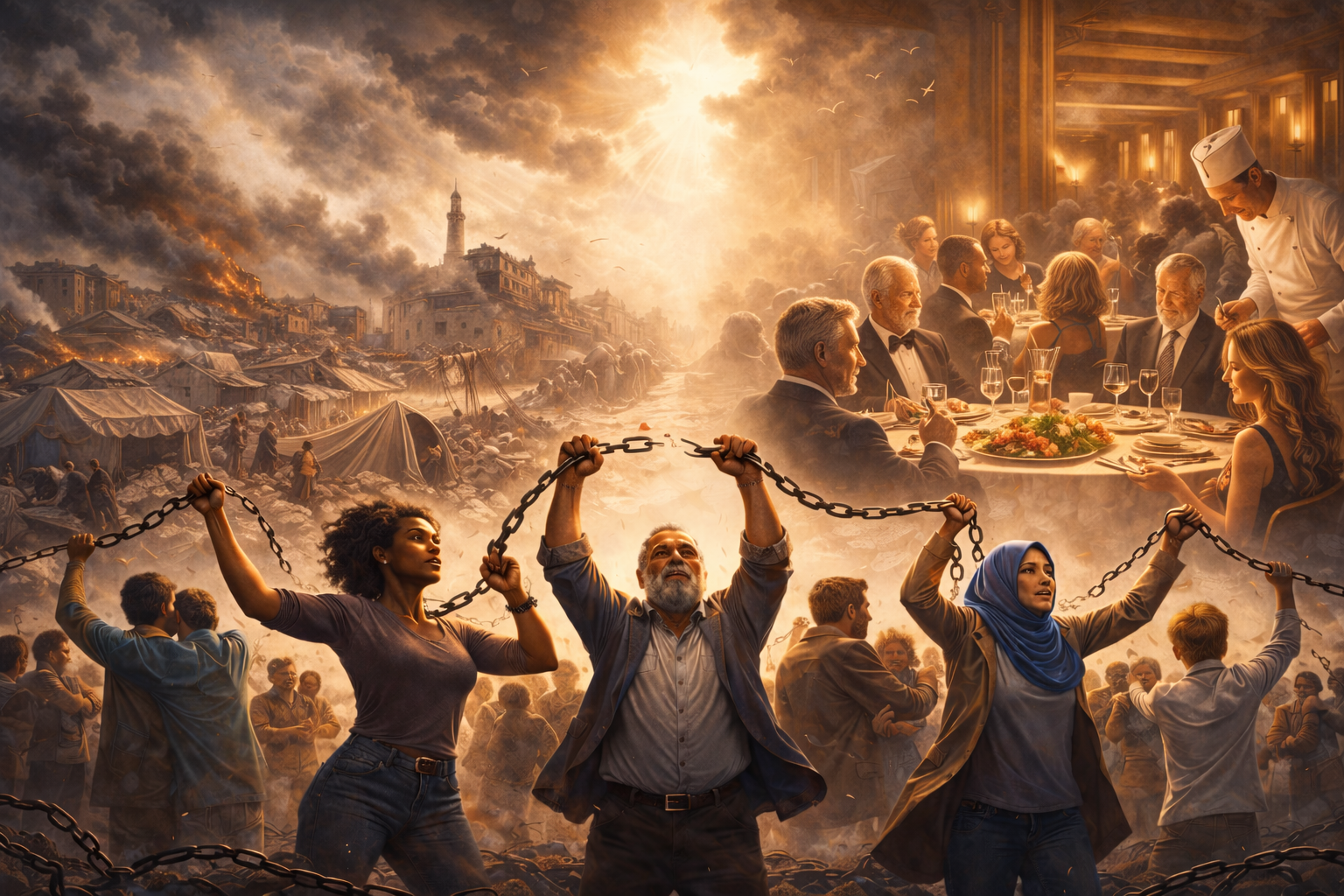
The following is an essay that was forming inside my head as I navigated my thoughts on some of the most pressing current themes that you will recognise:

I reject the exceptionalism of the Monroe Doctrine, the broader logic of American exceptionalism that implies that the Western Hemisphere belongs to the United States, and that it is entitled to do what it needs to keep the hemisphere isolated under its suzerainty.
Compared to other forms of exceptionalism, it is a relatively mild one, because Americans rarely camouflage it in elevated moral language or divine mandate. But its consequences have been no less brutal for the people of the South. It has justified coups, sanctions, destabilization, and violence while allowing Americans to imagine themselves as reluctant stewards rather than active agents of harm.
The theologian Reinhold Niebuhr, writing in the shadow of the two world wars, watched liberal idealism collapse into mass slaughter in Europe. He argued that nations are structurally incapable of moral innocence. They clothe their interests in moral language because admitting naked self-interest would threaten their legitimacy. He pointed out that power, once held, always seeks justification.
His assessment carried into the rise of the US as a global superpower. We have seen this repeatedly as the United States destroyed other societies while claiming to free them: Iran in 1953, Guatemala in 1954, Chile in 1973, Panama in 1989, Honduras in 2009 and even most recently and spectacularly, Venezuela. Exceptionalism here is displayed unapologetically with pomp for all of humanity to watch and accept as fait accompli.
Hannah Arendt, a German Jew who fled Nazi Germany and lived as a stateless refugee, pointed out something else – how it is ordinary bureaucrats who administer extraordinary evil. She warned that when politics is elevated to metaphysics, when a nation imagines itself as history’s chosen agent, ordinary moral limits dissolve. Ordinary people stop asking whether an act is right and begin asking only whether it is necessary. We see this repeatedly in Trump’s bureaucratic minions today.
Carl Schmitt, the lawyer who actually dismantled the Weimar Republic constitution to facilitate the rise of the Nazi regime, suggested that the sovereign is not the one who obeys the law, but the one who can suspend it. Schmitt’s insight was not a defense of tyranny so much as an exposure of how easily legal and moral systems can be overridden once a group convinces itself that it is exceptional.
Through the years, intellectuals from William Appleman Williams to Noam Chomsky have observed how exceptionalism evolved over time. Williams, writing during the Cold War, argued that American foreign policy was driven less by security than by economic expansion disguised as benevolence. Chomsky, shaped by the Vietnam War and decades of intervention, showed how exceptionalism functions as a propaganda system that teaches citizens to see their own violence as defensive and others’ resistance as aggression.
I reject the exceptionalism that China gives itself in the question of Taiwan. This position originated when two political parties both subscribed to the idea of “one China” in the aftermath of a brutal civil war and geopolitical crisis. Over time, however, both sides evolved into functioning nation-states with their own political realities.
Exceptionalism here operates by freezing history and denying consent. Through moral grandstanding, both sides remove themselves from the possibility of a workable solution. The only side that should matter is that of the people of the two sides given today’s realities. They needed to ask themselves, “who are we today?”. But when one side weaponizes history and declares its conditions non-negotiable, it erases the agency of the present generation.
China wields its temper against any person or country that does not subscribe to its narrative. Exceptionalism always demands silence from others because questioning first premises exposes the fiction. The pressure to conform is not a sign of confidence, but of fragility. It almost always results in great suffering before the narrative finally collapses or hardens into permanent repression. I can almost write the future of the history of China extrapolated simply from its insistence on holding this belief, and it is not a pretty one.
But most of all, I reject the form of exceptionalism that claims a people as “chosen” by a god fashioned around their own temper. This is the most difficult form of exceptionalism for me because I was raised an evangelical Christian and taught that the special relationship the Jewish people have with my God was central to my own salvation. My moral compass was pointed toward an apocalyptic horizon in which history itself would be redeemed through violence, and dissent from that narrative was treated as rebellion against the God that I thought I understood.
What makes this exceptionalism unbearable is its capacity to justify creating a state at the expense of other people who should matter just as much to my God as I do. There comes a point where we should never accept that murder and dispossession could be instruments of divine purpose. If God is God, he does not need priests, pastors, rabbis or militias acting as his self-appointed subcontractors.
I cannot accept that the dispossession of any people becomes righteous because it is dressed as destiny. The logic of being “God’s chosen people” cannot result in immunity from moral judgment. A religious concept cannot be allowed to become a political weapon. Edward Said, a Palestinian intellectual shaped by exile, insisted that human beings must not be erased by someone else’s idea of an abstract civilization. Said has as much reason to be heard by his creator as I do mine.
Antisemitism erases Jews as humans, and this is unequivocally wrong. But Jewish exceptionalism erases others as humans and this is just as wrong. Frantz Fanon, the black Caribbean psychiatrist who fought for France in World War II and then worked in Algeria, saw both sides of colonial domination and concluded that power survives by turning the dominated into symbols rather than people. Colonized people are no longer neighbors, workers, or parents. They become “natives”, “terrorists” and might I add “third world”. Once reduced to labels, violence becomes administratively easy. I am glad that many of my own Jewish friends do not subscribe to the political reading of “God’s Chosen People”.
I was trained to accept that my moral imagination must submit to a Book whose origins I am not allowed to question. For a long time, I accepted all the stories of cruelty in the Bible because I believed my own salvation required me choosing sides in an epic cosmic battle that has been postponed down the ages. But the anticipation of that epic battle has defined inevitability in western civilization. It has become deeply ingrained. It has all the makings of a self-fulling prophecy.
I accepted a deferred morality, one that permits suffering now because justice will arrive later. Today my position is that if this is salvation, then I will choose eternal damnation instead because the injustices around us today is already worse than hell itself. I am not rejecting faith. I am rejecting any faith that requires injustice, prejudice and preference to authenticate itself.
Exceptionalism stands in the face of a creator who loves all of humanity. A God who created the universe does not require centuries of suffering to complete his narrative. Theodor Adorno, writing after Auschwitz, warned against making suffering meaningful too easily.
There are also forms of exceptionalism embedded in Islam, just as in Christianity and Judaism, but because I am not Muslim, I do not need to resolve their internal contradictions for myself. All belief systems contain this software system operating inside people’s heads that trap them into self-justifying narratives. Those inside rarely see the inconsistencies. Those outside see them immediately.
There are forms of exceptionalism that men give themselves over women, white men over others, the Hindu upper castes over lower ones. It is endemic in human society. I am not suggesting that all forms of exceptionalism are identical in origin, intensity, or consequence. They differ historically, culturally, and psychologically. What they share is not content but structure: the move from identity to entitlement, from entitlement to exemption. The pattern is always the same. Someone is placed above, someone below, and someone benefits at the expense of the other.
Exceptionalism is a means by which people ascribe to themselves a certain privilege at the expense of all others. They justify behaviours and goals they reserve exclusively for themselves. It is how a group slides from identity into entitlement, and from entitlement into moral immunity. It is not merely pride. It is a political and moral weapon. It converts power into virtue and necessity into innocence. There is no moral symmetry.
So what is the cure to exceptionalism? Cosmopolitan thinkers like Kwame Anthony Appiah, Amartya Sen, and Martha Nussbaum, all shaped by plural societies and historical trauma, argue that difference does not erase obligation. We are all responsible to act in the interest of the other in the way we believe that we are entitled to have our interests safeguarded. Isaiah Berlin distrusts grand historical teleologies. Democratic theorists from John Rawls to Jürgen Habermas ground legitimacy in present consent rather than inherited destiny. Be present. Be kind.
So I reject exceptionalism not because I reject identity, history, culture, or faith. Instead, I want to revel in them. But the moment a people believe they are exceptional, they stop listening. And when they stop listening, they stop being moral. When they stop being moral, they become the very evil they say their God wants to save us from.