

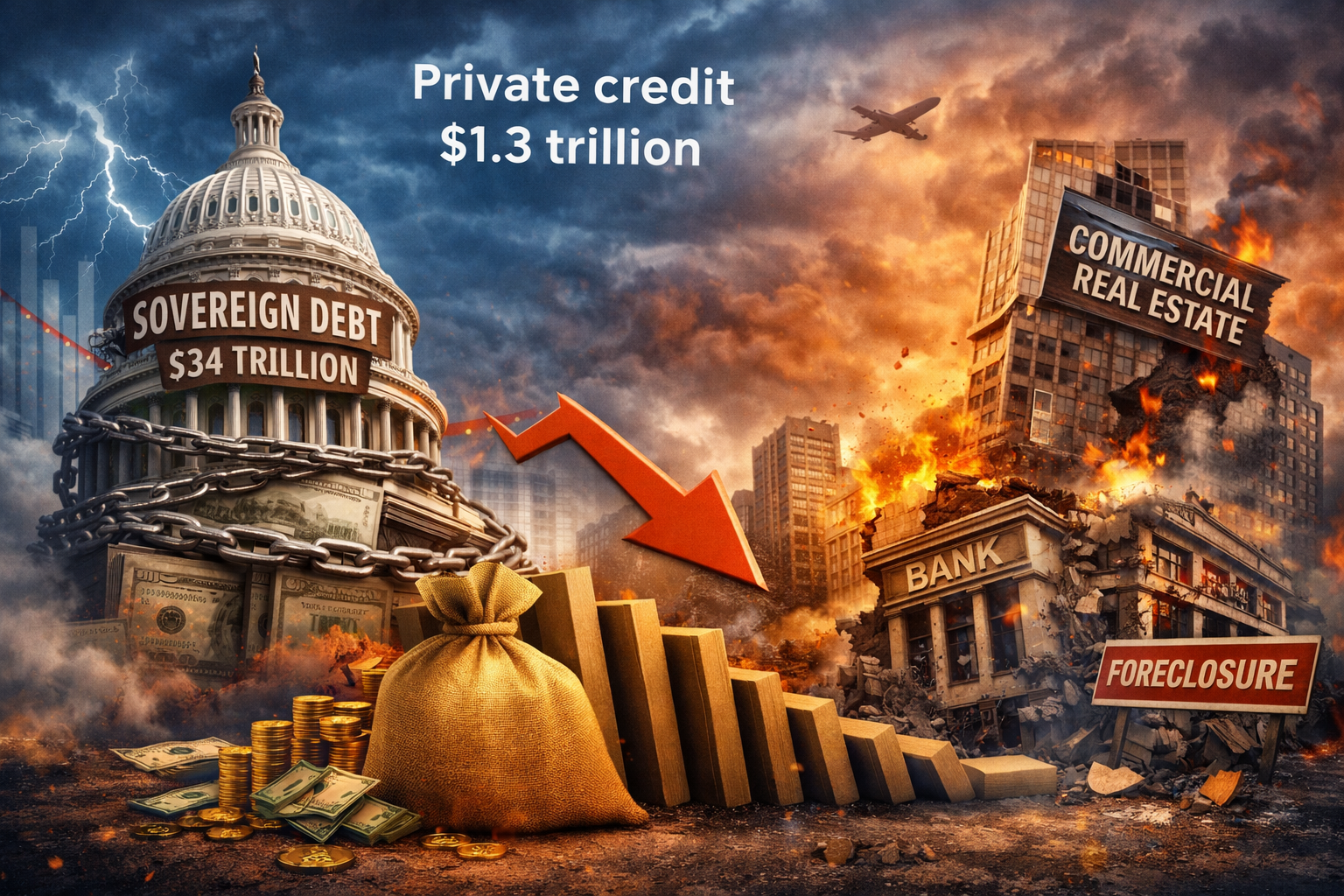
I am not entirely clear if I am missing something about the entire private credit wobble in the United States. The headlines are loud, and the anecdotes are lurid, but before declaring it a crisis, it helps to know the actual size of the beast relative to everything else that’s happening.

The U.S. private credit market, at just under $1.3 trillion, is not tiny, but it is simply not large enough to be systemic. According to the latest Federal Reserve numbers, the total assets of U.S. commercial banks is about $21.7 trillion, including roughly $13.6 trillion of loans and leases, of which $2.82 trillion are commercial and industrial loans. In other words, the banking system holds more debt than private credit lenders hands down.
The Fed’s broader Financial Accounts show $14.2 trillion of debt owed by U.S. nonfinancial corporate businesses at the end of 2025, including $7.9 trillion of corporate bonds, about $1.14 trillion of nonmortgage depository loans, and other mortgage, commercial paper, and nonbank loan liabilities. SIFMA’s market statistics put the total U.S. corporate bond market at about $11.5 trillion outstanding at the end of 2025. So, why are we fussing the smallest of all the commercial debt asset ecosystems?
US commercial real estate debt is around $5 trillion of which about $3 trillion sits in the balance sheets of banks. This is different because unlike private credit, commercial real estate debt is systemic. A commercial real estate downturn will be a direct hit to US regional banks.
The elephant in the room however is sovereign debt. Not just for the US, but for many systemically important countries. The total US federal debt stands at $34–35 trillion. Annual interest payments (at 2025 run-rates) are between $900 billion to $1.1 trillion and rising. It is now one the largest single line items in the federal budget.
Let me put it bluntly that it is not beyond the current Trump administration to default on its treasury bonds “just for fun”, as a last ditched attempt at grandstanding when everything else has failed. This will set in motion a chain reaction that will tear apart every other country, emerging and otherwise, with high cost sovereign borrowings and chronic budget deficits.
Global sovereign debt stands at about $70–75 trillion today, and the interest bill on that alone is estimated at $2.5–3.5 trillion annually. That’s simply much larger than the entire private credit market globally. The volatility or losses of the sovereign debt market transmits directly into global FX reserves, bank liquidity and collateral markets amongst others – all systemic institutions.
The IMF notes that the global private credit market tops $2.1 trillion in assets and committed capital, and that about three-quarters of that is in the United States. The ruckus appears to have been initiated by the New York Fed estimates that U.S. private credit is now approaching 30% of debt issued by below-investment-grade-rated companies, up sharply from the post-crisis period. But so what? They are using junk-bond capital market language to describe main street corporations.
Clearly, the private credit crisis is likely to disrupt credit pricing and tighten funding conditions for many of these corporations, but nothing they cannot handle. Also, 30% of $1.3 trillion is just $390 billion, a rounding error compared to bank lending.
The private-credit story is really about who now does the lending that banks once did. After the global financial crisis, regulation made many forms of middle-market and leveraged lending more expensive for banks. Nonbank lenders entered into the vacuum, and they were faster and simpler. Investors needed the higher yield. The volatility was taken off the hands of banks.
In my view, one genuine strength of the current private lending model that we really need to appreciate is that it treats borrowers less like tradable securities and more like responsible community institutions. A bank syndicate or bond market in the old days often behaved like a crew of firemen watching the exit with hoses in hand. A private-credit club deal is different.
The lender usually knows the sponsor, understands the cash flow, and can renegotiate quickly when a company hits turbulence. During temporary downsides, the parties keep the business as a going concern rather than forcing an unnecessary public collapse. The New York Fed explicitly notes that private lenders offer flexibility on terms, including adjusting interest payments or extending maturity, and that this can help mitigate defaults. That is also why industry data providers like the Cliffwater Direct Lending Index (CDLI) and large managers (e.g. Apollo, Blackstone, Ares) have loss rates that range from 0.1% to mostly below 1%.
That sounds like nonsense to the traditional bankers whose own default rates are twice that. But there is a real difference between managing a stressed company and merely liquidating one. Banks have strict obligations to liquidate bad assets after a fixed period, while private credit can hold on longer of fob it off to the next buyer.
What I think happens is that lenders off-load debt that they can’t handle at a haircut to the next lender who takes on the debt at a risk premium, and gives the corporation a but more time to rehabilitate, all behind closed doors. A lender can quietly amend, extend, capitalize interest, or take the keys without ever producing the public spectacle of a bankruptcy, keeping losses out of plain sight.
Private assets are infrequently valued, often model-marked, and may show smaller markdowns than more liquid leveraged loans even when credit quality is weaker. To be honest, it is time that we acknowledge private credit may genuinely be better at workouts for the good of society. There are plenty of data that point to how few stressed European and Asian borrowers end up in public bankruptcy compared with the number that undergo private restructurings because they are not subject to the same levels of transparencies that US markets are asking for. Private credit are not distressed junk bonds.
So can a fall-out in private credit damage traditional financial institutions? Not by a long shot. The IMF wrote that U.S. private credit borrowing from banks was estimated at less than about $200 billion, under 1% of U.S. bank assets, though some banks may have concentrated exposures. The New York Fed, citing recent Federal Reserve research, says the largest U.S. banks have extended about $95 billion in loans to private credit lenders. So why are traditional bankers like Jamie Dimon making such a hullabaloo about an impending private credit crisis? Because it is business that has been taken out of his hands and he can’t compete hard enough to win it back.
Insurance companies, pension funds and even private wealth looking for yields are far more exposed to private credit than banks are. They have no idea on marking-to-market their exposures, repricing their risks and have real liquidity concerns if and when the private credit market unravels. Investment banks have another vulnerability: potentially lower underwriting fees, warehousing risk around credit distribution, and counterparty links to structured products. The irony is that investors do not mind illiquidity when markets are boring and the yields are promising. They just like to know when the music stops. They are also the likely perpetrators of the current publicity on private credit because they will have little recourse if it happens.
My own judgment is that private credit is not the next subprime crisis in the simple, cinematic sense it is being portrayed. It is obviously not large enough, bank-funded enough, or maturity-mismatched enough to replay 2008 frame by frame. But it still matters to the entrepreneur on main street because, in a downturn, the first-order damage will be a squeeze on his access to credit. That would hit middle-market companies first, and the broader economy later.
The two largest threats to the US financial system today are the likelihood of a default on its sovereign debt and the likely fallout in the commercial real estate market, in that order, and the second is of a far less magnitude than the first.
My larger question is how come the media is not instead playing up the US propensity to default on its sovereign debt as almost a given. After the war with Iran, a sovereign debt default is such a natural weapon the current administration is totally capable of wielding to demonstrate its “power” on the world stage. A private credit fallout will in all likelihood be a non-event.