

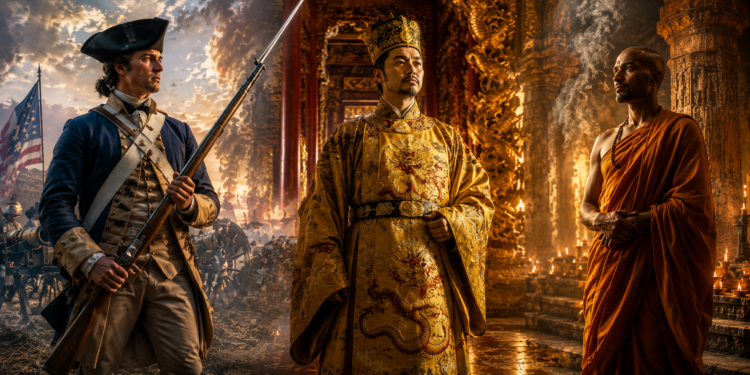
“The only clue to what man can do is what man has done.” — R.G. Collingwood

There is a fashionable habit, both among the people who admire China and those who fear it, of reaching back three thousand years to explain much of its current actions. We invoke ideas of the Middle Kingdom, the Mandate of Heaven, anecdotes from a civilisation with a long memory that was running a bureaucracy while Europe was still tribal. A trove of history from which to summon patterns that tell us what China will or will not do today. The Indians try to do the same. Civilisations with that much past must surely be carrying all of that character into the future. But did you notice that the logic disintegrates when applied to other countries with long civilisations, notably the Persians or the Egyptians. So we are selective.
I want to insist that the China that exists today is not as much an inheritor of that past, as it is trying to perfect a new creation. So is India. Yes, there are qualities from the past that still define these civilisational nations, but not in a blanket way that some try to ascribe. The Japanese tried it during the time of their ascendency in the 1980s and 1990s, when the world was told that keiretsu networks, kaizen and lifetime employment were not management techniques but expressions of a five-thousand-year civilisational character, arriving just in time to explain why Japan was about to overtake America. It did not.
The techniques were real, and useful, but none of them were ancient at all — the keiretsu were reorganised zaibatsu from the 1940s, kaizen was a postwar import via American quality-control consultants, lifetime employment was a labour bargain struck in the 1950s to buy industrial peace. None of it reached back further than a single generation. And once the model was mistaken for civilisational destiny rather than a postwar arrangement, Japan had nowhere to go when the arrangement stopped working. It is now left lost, trying to find the wind again in its sails, digging in the sands of the past that slips through the fingers.
This is not to say that there are qualities from the past that do not get carried into the present. I gave a speech earlier this year on how China’s manufacturing prowess today harkens back to its ability to organise as a manufacturing behemoth even from the Tang dynasty. Some important qualities do get carried down the ages and we do need to recognise them.
But in 1911 China made one of the most radical decisions any civilisation has ever made about itself. It chose to stop being ruled by a “mandate of heaven” downward and to be ruled, somehow, from the people upward. It did not know then what that meant. Nobody did. But it knew that things had to change. It then spent the better part of sixty painful years — through warlords, a republic that never cohered, invasion, civil war and the convulsions of the Mao era — trying to discover what a mandate from the people might actually look like. The country that emerged from that search, the one Deng Xiaoping began to shape at the end of the 1970s, is barely fifty years old and it is still a work-in-progress.
That is the real age of the China we are dealing with. Not three thousand years. Fifty. And it rests on a far more fragile foundation than its admirers admit. The Communist Party holds the right to rule on an important, self-imposed condition — that it keeps delivering prosperity. It has met that condition spectacularly, lifting more people out of poverty faster than any other government in history. But a mandate earned by growth is a mandate that can be lost very quickly when growth fades. Anyone who imagines the Party is somehow immune to losing its legitimacy, that three thousand years of civilisational habit will hold the structure up by itself, has not understood the fragile underbelly of Chinese politics. We simply do not yet know how China will govern itself when the economic version of the mandate runs thin. It has hitherto never had to. It is in this sense that China is a young country transitioning into an unknown territory it will navigate, not an old one.
The reach into the past also flatters China in ways the record does not support. We are told, often, that China was never an expansionist power, that it is constitutionally inward-looking, that unlike the West it does not export its system. It is a comforting story that conveniently forgets that in the 1960s and 70s, Beijing actively backed communist insurgencies across Southeast Asia, beaming revolution by radio into Malaya, Thailand and Indonesia and even into several African states, and unsettling several governments in its wake. By Lee Kuan Yew’s own account, it took a direct appeal to Deng Xiaoping in 1978 — sitting down with him and asking him, plainly, to stop — that the support was eventually wound back. Modern China has continued that expansionist streak. That’s a work-in-progress as it tests its own boundaries and the resolve of its neighbours to establish new norms that did not exist in the past. The foreign ministries in the countries that are at the receiving end of this missive know this only too well, while the armchair supporters negate any such tendencies.
The same flattery is at work in the map itself. The vast western and northern extent that the People’s Republic now treats as ancient and inalienable are the gifts of the Qing dynasty, and the Qing were Manchus. The irony is almost too neat: the territory Chinese nationalism holds most sacred were gifted to it by the foreign conquerors that also defined it. Han-majority China today has been learning what it means to organise a multi-ethnic country around this inheritance. It has the potential of eventually becoming a very cosmopolitan country. But whatever China creates from this inheritance, and the economic realities that it has to face as it confronts a dwindling population, will have to be written on a clean new slate.
And having inherited those edges, China now spends much of its strength testing them — against India in the Himalayas, against Japan in the East China Sea, against half of Southeast Asia with the nine-dash line it has drawn around almost the entire South China Sea. There is nothing from China’s past that can give an indication of how these will work out: press as far as the protagonists will bear, then retreat the moment it pushes back. What we are watching, then, is not the unfolding of an ancient script. It is a young state learning, in real time, what its new capabilities allow it to do — commercially, socially, and now militarily, across all three at once. What China will become as a global superpower, if at all it does, will be constructed on values very different from its ancient past.
And it is not only China that mistakes a recent construction for an ancient inheritance. India does the same, with even less to go on.
India carries itself as a civilisational force five thousand years old and, more recently, as an economy merely returning to its rightful place as a global economic behemoth. It is a civilisational force, let there be no doubt about that. But it was never the unified behemoth. There was simply no single India until the British forced it into one. A single country, under one constitution, holding the whole subcontinent from Kashmir to Kerala, is one of the youngest large states on earth.
For most of its history the subcontinent was a patchwork — a Hindu south, a long line of Muslim dynasties ruling the north from Delhi, princely states beyond counting, and only rare and partial unifications under the Mauryas or the Mughals. Indians hate to admit it, but what finally drew that patchwork onto a single map was the British Raj, and what holds it together today is a constitution written in 1950, not a memory carried down from the Vedas. India as a unified country is barely older than the People’s Republic of China.
The wrong story licenses the wrong excuses. A country convinced it was always destined to be a united power, and is simply returning to form, treats its fragmentation — of language, region, caste and faith — as a passing inconvenience rather than the central thing it must govern around.
And here is the uncomfortable thought: it has been China, with its achievements, that has kept India honest, and stopped it from offering its diversity as an excuse for its inability to hold together as a modern state. Strip away a rival of that scale on its border, and India will still be explaining away everything it fails to achieve as the natural friction of a vast and ancient civilisation. The competition denies it that comfort.
China’s literacy rate in the 15-24 year old range has been 100% since 2010, which enables its society to embrace change effortlessly, while India’s total literacy rate just passed the 80% threshold, and still in the 60% range for women. India remains the only large country that is a non-starter in the Olympics or other global sports, while tiny nations out-class it. These are indicators that forces India to behave like the painfully young, unfinished, deliberately assembled country it actually is.
Now set the United States beside them both. Americans are constantly reminded that theirs is a 250-year-old country, younger than some of the trees in Zhongnanhai in Beijing. But America never had its 1911 — never repudiated its founding premise and began again. The America of today is built on its founding events of 1776. There is no rupture to read across. What the country did in its first decades, it is, recognisably, still doing today. In fact, every time we are totally shocked that the US has acted out of character, we are able to dig into its unadultered history to find that it has been acting to form.
It is a nation built on war and then on the brutal dispossession of the native nations that preceded it. Within a generation of formation the young republic tried to seize Canada, in 1812; within two it had taken half of Mexico — California, Texas and the whole south-west — through deception and wars of open conquest. It declared an entire hemisphere its sphere of influence under the Monroe Doctrine, and enforced it with a big stick. It went to war with Spain in 1898 and came away holding the Philippines, where it then fought a brutal campaign to keep them.
It put marines into Cuba, Haiti, the Dominican Republic and Nicaragua so routinely that the interventions barely made the newspapers, most of them in the service of its own corporations. Half a century later the pattern had simply changed its instruments — in 1954 a sitting Secretary of State, John Foster Dulles, helped engineer the overthrow of an elected government in Guatemala, while his brother ran the Central Intelligence Agency that carried it out, and the law firm both men had built their careers in had spent years representing the United Fruit Company, whose land the Guatemalan government had proposed to nationalise. The uniform changed from marines to CIA case officers. The logic did not change at all and so it continues to this day.
The same country that wrote the most eloquent constitutional case for personal liberty the world has produced, has without a wink of contradiction, been continuously willing to use force to arrange the world to its advantage. The eloquence and the belligerence are not in tension. They are part of the same monologue, doing what it has always done. It does not even matter who the personalities involved are. It is the nation that never fails to throw up personalities that reaffirm its belligerent form.
The same Thomas Jefferson who wrote that all men are created equal owned more than six hundred human beings across his lifetime and freed almost none of them. When we wonder how disgusting an American president can be, we need only recall that the writer of the founding case for liberty, while serving as the young republic’s minister in Paris, began a relationship with Sally Hemings — a girl of perhaps fourteen, enslaved in his own household and, by the cruel arithmetic of the plantation, the half-sister of his late wife. She bore him six children, born into his ownership.
The paternity, long denied, was settled by DNA evidence in 1998, and Monticello itself now states it plainly. This was not a private vice uncovered after the fact. It was the daily texture of a man’s life, lived alongside the most luminous sentences ever written about human freedom. The capacity to author liberty and to own a child by the same hand, and to feel no fracture between the two, is not an American aberration. It is the American foundation, seen close up. The eloquence was always real. So was everything underneath it. When it happens again today, in the Epstein files no less, we shudder that nothing has really changed.
The consistency is not only in asserting armed conflicts. I have argued elsewhere that Chinese banks badly underestimate how readily the United States will change the rules of the financial system the moment its interests require it — freezing reserves, weaponising the dollar, turning the plumbing of global money into an instrument of policy. This is a reflex inherited from the European banking houses, when they engineered the Ottoman Empire into a financial colony in the nineteenth century, installing foreign tax collectors inside a sovereign state and wiring its salt and tobacco revenues straight to London and Paris. It is narratives like these that we need to look out for, that is extrapolated into how Western nation states can be expected to behave today.
So the real question is not which country has the deeper past. It is which country’s past actually tells us anything about how it can be expected to behave today. China’s three thousand years are a poor guide to a state that consciously broke with them and is only five decades into deciding what it now is. India’s five thousand are a poorer guide still to a union the British drew onto the map and a constitution written in 1950. America’s two and a half centuries, by contrast, are a near-perfect guide, precisely because nothing was ever broken off. Collingwood’s line was not a piece of cynicism. The only clue to what a country can do is what it has done — and the country that has done the same thing, in the same spirit, for the whole of its existence is not the inscrutable one. It is the legible one.
All of this becomes even more relevant as humanity transitions into the artificial intelligence age. AI is threatening every nation with new ways of organising, new forms of economic activity, redefined ideas of work, industry, leisure and social value, that none will be able to draw from any past to bunker its future. The irony is that those of us from more stable societies see all the social and economic upheaval in the US today and pontificate that it is all about to implode. The instruction from its 250-year history is that it has always lived on the precipice — at its inception, during its civil war, through every economic crisis since. There is nothing new about the US. It thrives on chaos. The rest of us not so much.
In this regard the US has one advantage that serves it better than any other nation: it does not, at bottom, care enough whether it holds together as a nation at all, and yet it does. It is not even designed to care enough, representing as it does, a plethora of conflicting groups pursing their own interests in the name of liberty. This alone makes it far more malleable in navigating change and in redefining itself in a way that gives it the license to continue defining our collective future. Legacy civilisations care too much about preserving a past that does not even define them today, and so they become brittle. These are the ones that run the greatest risk when upheavals finally require them to adapt.
We have it backwards, then, when we cast the ancient civilisation as the one we can read and the young republic as the unpredictable adolescent. The opposite is true. China is the genuine mystery, because it is still writing the only history that counts — its current one, the one that began when it decided to be governed from the people up. The United States is not a mystery at all. It has been telling us who it is, plainly and without interruption, since 1776. The discomfort was never that we could not read it. It is that we always could, and so often chose not to.
Emmanuel Daniel