

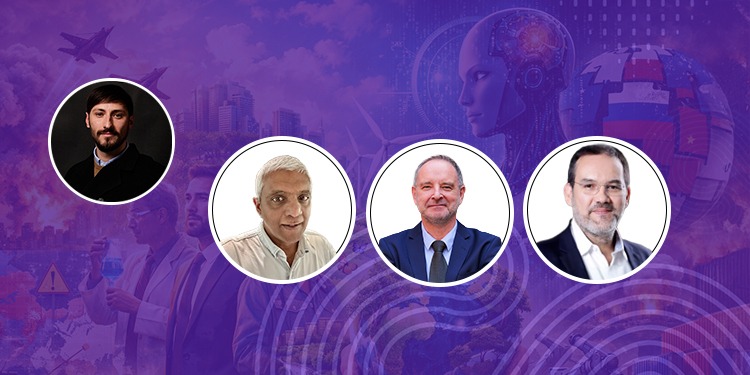
The discussion opened on what Leonardo called the “double helix” defining global business today risk and opportunity moving together across geopolitics, technology and markets.

One point I made is that in banking and finance, AI is reshaping the industry across two layers.
At the front end, power is shifting to the end user. Banks historically controlled when and how customers engaged through branches, channels and batch-processed systems. AI changes that. Individuals will increasingly deploy agents to transact, manage liquidity and interact with financial institutions on their behalf.
The app era becomes transitional. The next phase is programmable finance delivered through APIs, where customers or machines acting for them decide how they interact with banks.
At the back end, operational layers are converging. Middle and back office functions are merging into unified data environments capable of extracting real-time meaning from customer and institutional flows. Banks are moving from transaction processors to intelligence platforms.
We also explored geopolitics through a structural lens.
I tend to look at the underlying forces shaping national behaviour. One is the financialisation lifecycle economies move through from manufacturing, to services, to high-tech production, and ultimately to financial systems where capital markets dominate economic logic.
The United States is simply the most advanced expression of that evolution. Trade tensions and tariff regimes reflect the behaviour of a deeply financialised economy protecting asset value. Other nations will move along similar paths as they accumulate wealth.
Tom brought an operational counterpoint on supply chains. Diversification strategies such as “China Plus One” are rational but complex to execute. Multi-country sourcing increases cost, fragments logistics and creates internal corporate tensions between geopolitical signalling and operational reality.
Resilience carries friction.
We also discussed emerging markets, where growth remains strong but execution depends on local trust infrastructure. Technology can accelerate research, but it cannot replace in-market presence, legal embedding and long-term relationship building.
Edmundo illustrated how these same forces are playing out in healthcare manufacturing AI training, customer-centric product design and domestic production partnerships advancing in parallel.
Listen to the full podcast:
Some of the themes we covered:
- Fragmented globalisation and supply chain resilience
- Agentic AI and programmable banking distribution
- Operational convergence inside financial institutions
- Financialisation as a geopolitical lens
- Trust infrastructure in emerging markets
- AI and localisation in healthcare supply chains
The broader point is that globalisation is not reversing. It is being redesigned.
Trade routes are shifting. Technology stacks are compressing. Capital is more selective. Labour markets are reorganising around automation and skills.
Institutions that succeed will build optionality diversifying dependencies, embedding AI into operations and positioning themselves inside growth markets rather than observing from afar.
I closed with a story from our early expansion into Africa. When asked what we would call ourselves there given our identity as The Asian Banker, my answer was simple.
The name did not matter. Presence did.
It doesn’t matter what you call yourself, as long as you turn up.