

So far, India has been playing the geopolitical stage as if it could have its cake and eat it. It is a member of the Quadrilateral Security Dialogue (QUAD), the US-sponsored anti-China coalition, while at the same time a member of the China-backed Shanghai Cooperation Organisation (SCO), while still having unresolved border disputes with two of its principal members. It reserves the right to be associated with both or any groupings, with no discernible policy direction to guide its friends and foes alike.

Both great powers, the United States and China, have their own claims to exceptionalism. The Americans are the self-appointed guardians of democracy and policemen of the world. As for the Chinese, the time has come for the rejuvenation of the great Chinese people, and that there is only one China, with all its contiguous borders that are theirs and theirs alone to define. Indian exceptionalism is based on being the youngest and largest nation on earth today, with an ancient civilisation and a GDP that we are repeatedly remind was thwarted by the British — forgetting of course, that it was successive Muslim rulers who gave India any semblance of a civilisational state in the generations before the British.
To the present. India has been squandering whatever potential goodwill it had on the global stage by a whole lot of grandstanding, articulated in the arrogant verbiage of its spokespeople, starting with its foreign minister, S. Jaishankar, who is indeed eloquent at calling out the hypocrisy of all others — except his own. In an age where all the major countries are juxta-positioning against each another for maximum benefit, few are naïve enough to swallow another’s rhetoric wholesale.
In substantive terms, India has been playing its cards poorly for at least a decade now. It effectively crippled the South Asian Association for Regional Cooperation (SAARC) coalition of South Asian states after 2016, and all that the other member states were expected to do was wait for India to decide how it wants to play. In the meantime, India believed itself suited for more important things on the global stage and invested in relationships with the West who proved to be even less reliable as friends. It had an opportunity to prosper its neighbors, but lost it.
In the meantime, Bangladesh’s per capita GDP inched higher than India’s, and Pakistan invested in a China-designed military with digital warfare capacity the Indian armed forces have not even begun to fathom. Meanwhile, China has inserted itself into the vacuum as the convenor of South Asian unity by creating its own dialogue platforms under the Belt and Road Initiative. Sri Lanka is effectively a Chinese vassal state. India has only itself to blame.
While China is a very aggressive global superpower today, its border disputes with India could have been solved at the very inception of the Chinese state in 1949 when China was poorer than India. Beijing asked then, and it is asking now. But subsequent Indian leaders simply refused to bring a final settlement before their own parliament, playing charades around the ambiguous term “Line of Actual Control” instead of ratifying clear borders. That’s Indian exceptionalism for you, that they reserve the right to create impossible situations that others will have to tolerate at the maharajah’s pleasure.
The difference today is that China is a superpower with a million troops at the border, supported by the most advanced digital arsenal — drones, robots, missiles, cyber-warfare infrastructure — capable of ending a conflict before Indian generals finish their afternoon tea. It’s no longer about building roads and training terrain-ready soldiers in a hurry. And now Pakistan too, jamming their radars and downing six Indian jets even before they could leave the country. The terms of engagement have moved on, but the Indians still think they control the narrative.
The Indian armed forces remain suspended in time. The navy, army and air force still operate with an old-world understanding of each other’s roles. China’s own contested “Jammu and Kashmir” are Xinjiang and Tibet. These are managed not only with unapologetic repression but also with infrastructure, jobs, a common Mandarin language education, and incorporating the minorities into the mainstream, but on Beijing’s terms. Whether the western world likes it or not, the state is in control of the narrative.
The alternative for China would have been a permanent insurgency, as Jammu and Kashmir is for India. Yes, the desire for secession remains strong in China’s frontier provinces, but it is a case of “either you control the narrative, or I do.” In India, the generals live for promotions, decoration, and a handsome pension when they retire. It is in their interest to keep the sense of insurgency going, whether in Kashmir or downtown Delhi. So Kashmir will always be Kashmir, Pakistan will always be blamed for terrorism, and nothing will change that. Always someone else controlling the narrative. But in the same way that the Israelis hoodwinked the world that the Palestinians were the terrorists, the Indians cry of wolf on the Pakistanis have been falling on deaf ears.
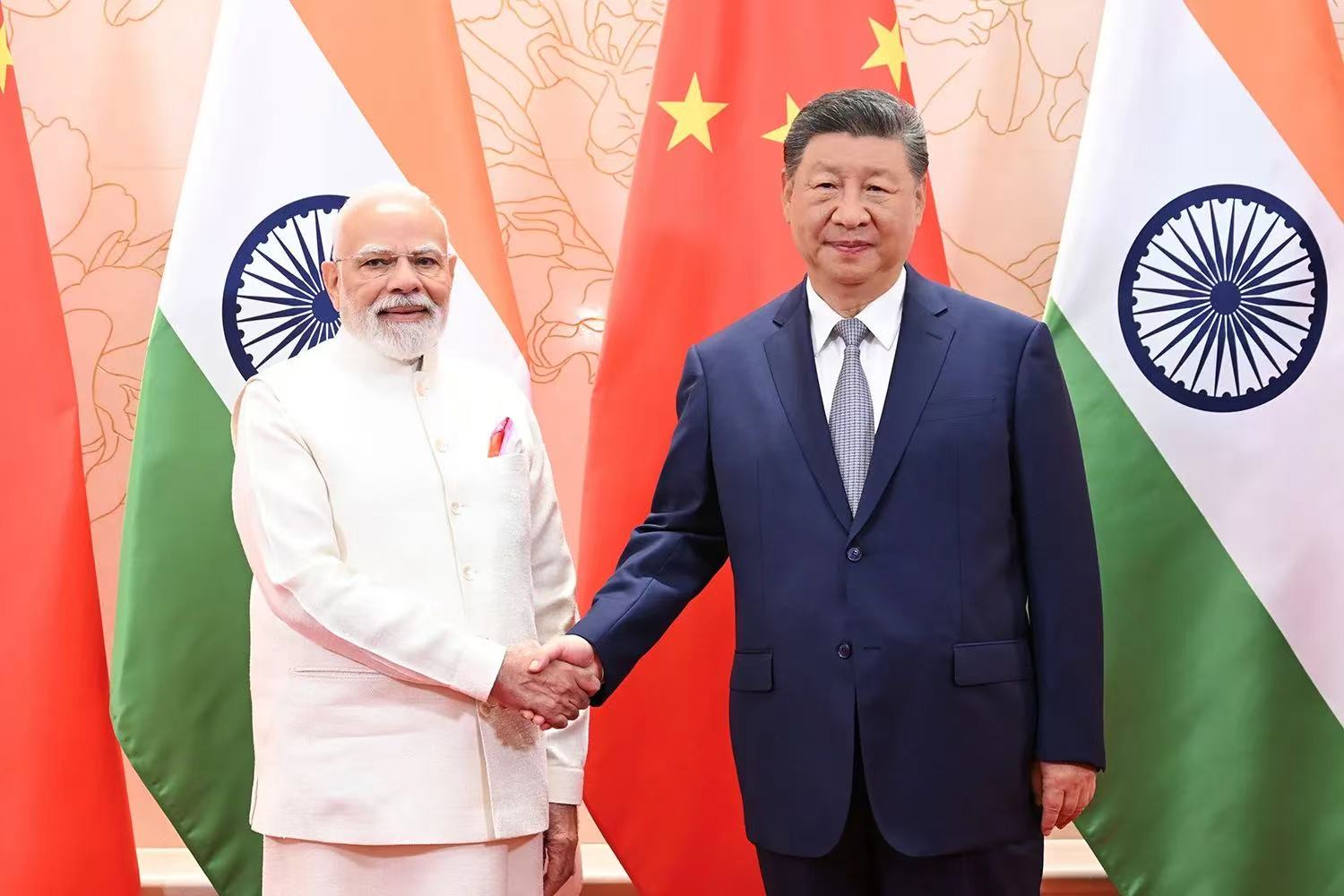
So against all this, Prime Minister Narendra Modi turned up in China last week to attend the SCO meeting. A sudden change in posture? Not at all. Merely a continuation of the arrogant presupposition that India can fool all the people all the time. Modi wants to make next year’s BRICS Summit a resounding success and position himself as a super-something. The trouble is, that agenda has already been taken out of his hands. BRICS has been hijacked by China as a China+ coalition of new members — Saudi Arabia, the UAE, Egypt, Ethiopia, Iran — all of whom applied to join at Beijing’s instigation, even if some of the official invitation was from Russia. On Chinese social media, the joke is that China’s plan is to replace the “I” in BRICS with Indonesia, and make the coalition an extension of itself.
In its arrogant desire to be taken seriously by the West, India has also neglected to invest in building goodwill with the Global South, unlike China. To come late to the game, after skipping previous meetings in Beijing and elsewhere where developing countries gathered, and without building a coalition of its own, India now finds itself an outsider. China will of course support India’s BRICS presidency next year, it costs them nothing and only because it sets the stage for China’s own presidency the year after, when it will showcase its own leadership of the Global South in full splendor. By that time, it will no longer need India and may well revert to belligerence over the border. Any number of issues can scupper India’s desire to manage the narrative to achieve its shallow goals. If the Dalai Lama dies in the interim, it will expose the real rift of the relationship on both sides.
In the meantime, the United States does not take India seriously and can use it as a whipping boy in a way it never would with China. Already, Washington has slapped a 50 per cent tariff on Indian exports in August, while it dares not enforce its threats on Beijing, running protracted and endless negotiations instead. This weakens the Indian economy dramatically and India’s ability to negotiate terms even with countries that view it favourably, like Japan, an arch enemy of China.
The India we are seeing today is not the India of independence, when it was a true believer in the Non-Aligned Movement and a beacon of anti-colonial solidarity. Then, India stood firmly with the Palestinian people in their quest for self-determination. Today, it is closer to Israel, signing multiple defence contracts in drones, weapons and missile systems — and in so doing, placing itself on yet another precipice that puts it on the wrong side of history.
The petty arrogance of India as a would-be rising power stands in stark contrast to the painstaking investments China has made to earn leadership of the developing world. Not that China will not abuse its position — it surely will — but at least it has invested enough to make the friends and cultivate the enemies who respect it. India, on the other hand, is losing the friends it thought it had, and alienating those whose friendship it could have had.
It is not difficult to see why the next three years are not going to play out the way they are wishing it would. Geopolitics is not an opportunistic, headline grabbing memes game, although it seems like it is. The winners are those countries and corporations that have invested in and strengthened their own narrative that they can control. When the time comes, they capitalise on that investment. There is still so much that India has to do internally as a country to give it that status on the global stage.
Meanwhile, Indian intellectuals and elites, resplendent in their command of English and in their cricket, pass their time berating Britain for a colonial past that ended nearly 80 years ago. Now that the reins are firmly in their hands, they are in no hurry to create a new narrative or chart a course that might unleash the full potential of this otherwise powerful civilisation and its highly talented and hardworking people. For the rest of us, it’s all theatre, while the substantive stuff goes unattended.