

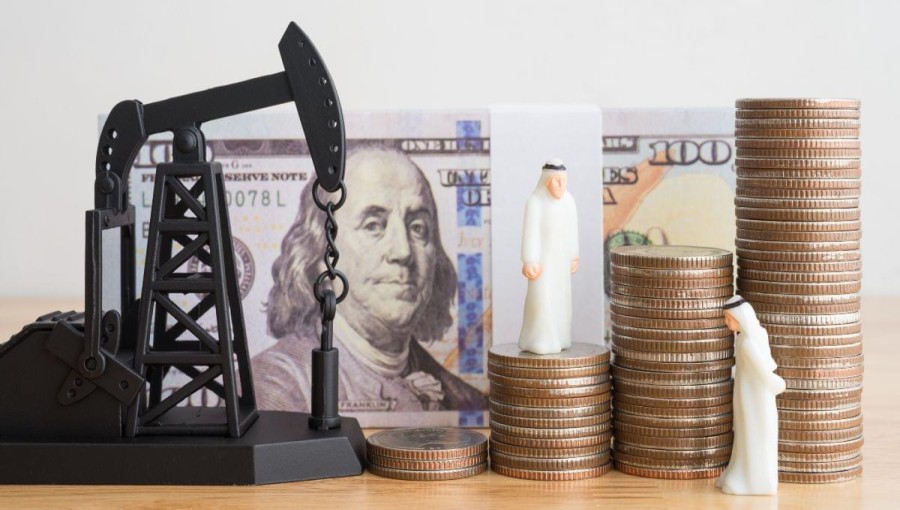
There are some reports going around saying that the U.S.-Saudi petrodollar agreement of 8 June, 1974 has officially lapsed on 9 June 2024.

If this is true, it represents an important end of period of the use of the dollar in the oil market.
But I can’t find any coverage of this in the mostly western business press, which can be biased on some days. My own research tells me that there is no “lapse” date and that the U.S. and Saudi are currently working on new agreements pertaining to the Gulf in general which will be announced very soon, and that if there was an intentional “lapse”, either one or both would have stated their intention.
Much as I would love to support the commentators who have been using the end-of-petrodollar era to justify the end of the dollar itself, the facts present a very different story.
According to the U.S. Energy Information Administration, the U.S. currently imports more oil from Canada and Mexico than it does from Saudi and that the U.S. is itself a net exporter of oil.
Other data suggests that Saudi biggest customer is China, so making a bilateral agreement on a currency swap, given the size of their trade with each other, makes perfect business sense. They were in all likelihood formalizing a long-standing arrangement already in place.
So the end-of-petrodollar argument may well be a non-event for the end of the dollar as the global reserve currency. Although it is amply evident that every major economy and trading bloc are looking for alternatives to the dollar, the rise of alternatives will co-exist with a weakened dollar in a multi-polar world for a long time to come.
When it does come, the end-of-the-dollar would be caused most likely by a loss of confidence in the U.S. meeting its own debt commitments and the rise of a new reference currency, which today can also be a crypto-currency. A successful stablecoin will have the effect of taking the underlying currency into the digital realm, and on this front, dollar-based stablecoins are well ahead of all other options.
The more significant recent development was the U.S. Congress voting to kill any idea of a retail CBDC in the U.S. This puts both the US and China at loggerheads with the Bank for International Settlements (BIS), for two different reasons.
The BIS has already been actively discouraging retail CBDCs amongst its members, in favour of tokenised deposits. This puts it at odds with China’s digital yuan project which has been a pilot for too long.
The U.S. on the other hand, will reject anything with the words “CBDC” in it, but it desperately needs to digitise its currency in order to prolong its continued acceptance. It is my belief that the stage is set for US regulators to approve their banks to issue and compete with each other on their own versions of stablecoins.
In a world where inaccurate opinions are being sloshed around to support petty biases, the future will be nothing like what the alarmists would like us to believe.