

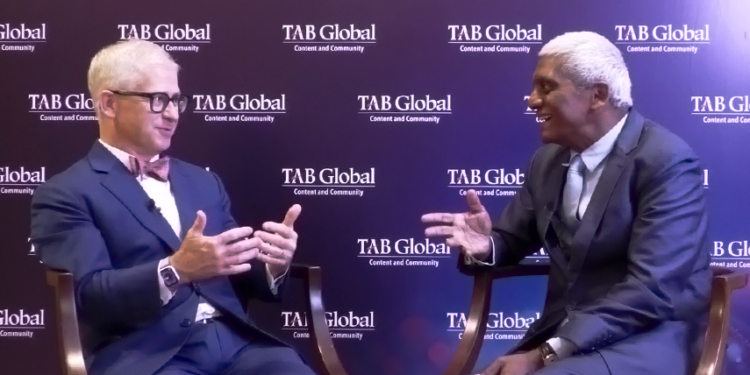
I spoke with Patrick McHenry at The Asian Banker Summit 2026, held at the Mandarin Oriental in Kuala Lumpur, on how US policy is reshaping banking, technology and global financial markets.

McHenry, who served in Congress from 2005 to 2025 and chaired the House Financial Services Committee from 2023 to 2025, described AI and digital assets as the two most significant policy shifts between the Biden and Trump administrations.
On AI, he argued that the United States has moved away from a regulatory-first approach towards a more open model that allows new large language models to diffuse across markets. He linked this shift to the rapid build-out of AI infrastructure and its contribution to US economic growth.
On digital assets, McHenry said the change has been even more consequential for banking and financial services. During the Biden administration, regulated financial institutions faced major restrictions in engaging with digital assets. That environment has now shifted towards legal clarity around payment stablecoins and broader digital asset trading.
We discussed how McHenry built bipartisan support for digital asset legislation by working with Democrats who saw the need for clearer rules. He said wider ownership of digital assets and a more mature industry helped policymakers look beyond ideology and focus on durable regulation.
The conversation also examined the role of large banks. McHenry said major US banks were not central to earlier crypto policy debates, but have become more engaged as legislation has moved closer to becoming law. He expects digital assets to become part of banking rails rather than remain a separate industry, much as fintech has become embedded in banking.
We also explored the Clarity Act, stablecoins, tokenised deposits and the possibility that mid-tier banks may use new rules to compete more aggressively with larger institutions. McHenry argued that the shift will not happen like a light switch, but through competition around faster, cheaper and more durable financial infrastructure.
A broader part of our discussion focused on the independence of US regulatory agencies. McHenry said financial regulation is likely to become more closely tied to presidential cycles, with Treasury playing a stronger role in coordinating agencies. He drew a distinction between financial regulators and the Federal Reserve, which he expects to remain institutionally distinct because of its role in monetary policy.
We also spoke about his decision to leave Congress. McHenry said he stepped aside after reaching the point where he felt he could no longer be more effective in the next Congress than he had been in the previous one. He now works in advisory roles at the intersection of finance, technology, regulation and geopolitics.
Here’s what we discussed:
- Why AI and digital assets define the current US policy shift
- How digital asset regulation gained bipartisan support
- Why stablecoins and the Clarity Act could reshape banking rails
- How large banks are responding to digital asset legislation
- Why US regulatory agencies may become more tied to presidential cycles
- What McHenry is doing after two decades in Congress
Watch the full conversation: