

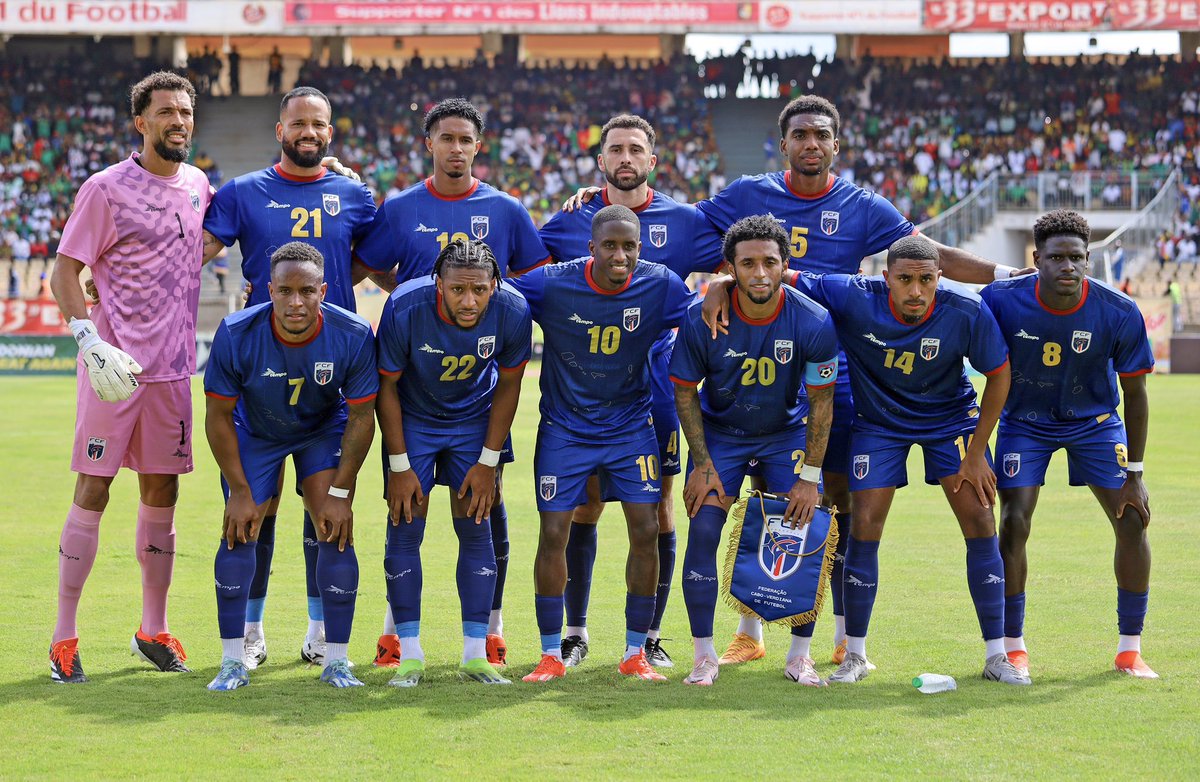
I had to get to Cape Verde in time for the now-famous match against Argentina. It was going to be the 163rd country I would visit, and it had to be on a day when, if they won, would have been the most important day in its history. So, despite a small technicality in getting a pre-arrival visa approval in time, I was there on the restaurant street in downtown Praia, on this most memorable of evenings, to visit a tiny country on a day that the country was not going to ever forget.

I am a student of why tiny countries are able to hold their own on the world stage, especially in sports, and of how that is extrapolated into everything else. Before Cape Verde (population 600,000) turned up on the football World Cup rankings, it was Iceland (400,000) and Croatia (3.8 million). I don’t think that the Icelandics even tried too hard. It was the natural talent of an entire people, something that larger countries could only look at with envy. China, with its 1.4 billion people, was totally mesmerized by Cape Verde this season, and totally disgusted with itself that it is so good in so many sports except this one. With all the money and talent it has, it could not hold a candle to this tiny island state. If Japan’s own reckoning is anything to go by, its determination will pay off eventually, in its own style. But still, there are lessons to be learnt.
In the game that I went to downtown Praia to watch, Cape Verde lost to Argentina, but with dignity. They played really well and held the Argentinians at bay until the very end. But my interest in Cape Verde was not in whether they won or lost, but how is it that they came so far. Cape Verde’s secret is its diaspora. An estimated 1.5 million Cape Verdeans live outside the country. As it turned out, the diaspora had a disproportionate number of football players in prominent teams, especially in Portugal, the Netherlands and France. So, from as far back as 2000, the football association had started contacting them, often without enough funding even for itself, in the hope that it would be able to put together a rag team of professionals that could amount to something. Someone in the system had a vision of sorts.
The postcard story that emerges is that of defender Roberto Lopes, of mixed parentage, found in Ireland by former coach Rui Águas. He first sent Lopes a LinkedIn message in Portuguese, and was ignored for nine months as spam. He resent the message in English, and then Lopes replied. A Portuguese football star in his own time, and married to a Cape Verdean, Águas painstakingly tapped at least six of the team’s members through informal referrals and by watching YouTube videos, at times while not being paid his own salary.
The present coach, Pedro “Bubista” Leitão Brito, built on Águas’s legacy by holding together a squad made up of players from four different continents and who met for the first time only days before a qualifier. He glued the team with a common purpose — their roots — and it showed in the way they played. There was no grand strategy in any of this. Someone just kept trying, putting together one man at a time, one day at a time, over a decade, until the whole plot somehow held together. Cape Verde football had no homeland depth to talk about, so the people who imagined this were drawing from the larger nation that existed only in their minds. But for athletics in competition in Jamaica is intense.
Team sports are motivated differently from individual sports. I also follow the Jamaicans in athletics, tiny sprinters like Shelly-Ann Fraser-Pryce explode onto the world stage, but from a totally different ecosystem. In Jamaica (2.8 million), it was hundreds of individuals competing with each other at the grassroot levels to throw up a few who break through to the world stage. Jamaica and the Bahamas (400,000) have spent many years since the 1950s building the momentum that we now see exploding in the Olympics and other global competitions. There was a time when some people postulated it was because Jamaicans were genetically natural athletes from their African origins. But tracing their roots back to West Africa, there was little evidence of athletic talent from that part of the world. The Kenyans were long distance runners. The Jamaican girls, Shelly Ann Priyce, and others were also physically tiny compared to their American counterparts who had larger albeit lighter body frames. Similarly Fiji (930,000) in rugby. They are smaller in size than the Aussies and the Kiwis. So, it had to be something else.
The social construct of the local population goes a long way in throwing up winners. For this reason, I follow closely the countries that are on the verge of throwing up their own giants. Singapore, where swimming is a favourite past time built into a competitive local sport and has thrown up its first gold olympic winner in the form of a Eurasian kid who was physically larger than the majority ethnic Chinese population. I was in Eritrea earlier this year and saw hundreds of cyclists training on expensive bicycles in the mountains. I was told that their inspiration was their own Biniam Girmay, the first African rider to win a Tour de France stage, in 2024 — he went on to win three that year. So don’t be surprised when this country eventually breaks through on the world stage. These things don’t happen overnight.
What Cape Verde has achieved is also a quiet judgment on the tragedy of larger nations, India among them, that do not care enough to bring out the better promise of their own population. It is almost a foregone conclusion in the minds of many today that Indians are simply not great sports people. But it is impossible that a country of 1.5 billion people cannot throw up even a handful of world class sports people.
When it comes to assessing why India does not throw up enough global sports talent, there is a controlled experiment that has been taking place outside of India for several generations now. In Southeast Asia, where there is a large Indian diaspora, made up of immigrant south Indians brought in as coolies by the British from about 200 years ago, sports talent is thriving. In Singapore and Malaysia, Indians comprise an outsized representation in sports relative to their 10 percent or less of the local population. Some even holding national and regional records in athletics, in countries with immigrant Chinese and Malay citizens who are just as good if not better at sports. So why is it that Indians outside India excel while an entire country languishes?
The simple explanation is that the layer that governs and defines India today are simply supressing the talent pool that exists. The answer, it appears to me, is who controls the narrative in society and in the country. In a country where Hindu radicals perpetuate the caste system and a lack of concern for physical fitness, the talented sports people do not have the sufficient support of the state nor their local communities to excel.
India is governed today by corrupt and racist politicians who do not just don’t care for sports, but actively undermine it through their narrow, parochial lenses. The few sports people who break through do so at great personal cost, after enormous hurdles in their local communities and at the state level. Even when the state says it supports them, it is not to the level of hiring foreign coaches and trainers if needed, driven by bigotry, lack of funding and a sense of misplaced self-confidence on the global stage. We will just have to wait until the country is governed by the leaders who will invest in bringing out the best in its people.
But for tonight, I have to contend that losing to the mighty Argentinians in style was good for the Cape soul. The experience has charged an otherwise hapless people to imagine that they can do better — not only in sport, but in anything they set their minds to. That is the best byproduct of a sporting nation, and I was there to watch that happen to one of the tiniest nations on earth.
———
Please click my TikTok or Instagram accounts to watch my videos in Cape Verde. It was great fun!