

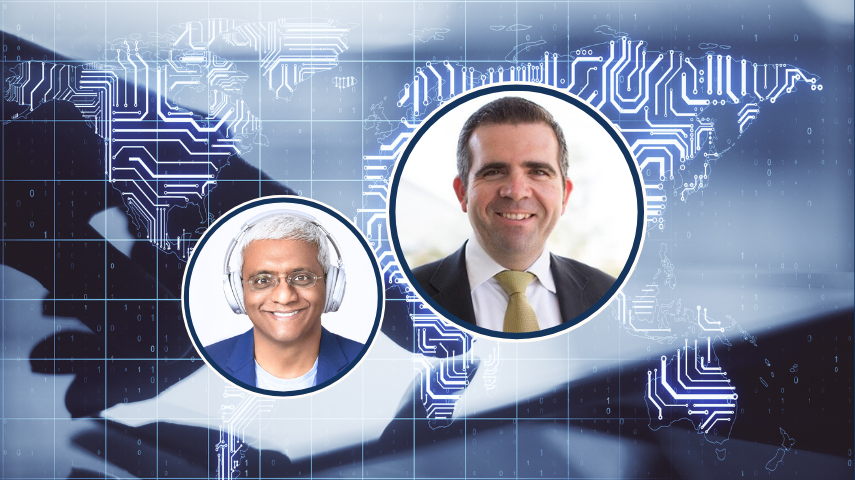
Gene framed the discussion firmly around macroeconomics rather than markets or personal finance, which allowed us to step back from daily headlines. Long before the latest tariff threats, multilateral trade regimes had already been weakening following the breakdown of the Doha Rounds. In that sense, Trump is not an anomaly, but another phase in a longer structural shift.

I argued that while trade dominates political rhetoric, it no longer represents the decisive source of leverage in the global system. Trade flows amount to roughly a trillion dollars. Capital flows, by contrast, run into the hundreds of trillions. The real advantage the US still holds lies not in tariffs, but in its dominance of global capital markets, financial infrastructure and information flows.
Here’s what we discussed:
- Why trade wars miss the real issue: How the erosion of multilateral trade predates Trump, and why tariffs alone cannot reset global economic relationships.
- Capital flows as the US’s last major leverage: Why control over capital markets and information transparency matters more than goods trade.
- Pushback from emerging economies: How countries such as India and Indonesia are resisting US financial services firms by building domestic payment systems.
- From currency wars to platform wars: Why competition is shifting toward payments infrastructure rather than reserve currencies.
- BRICS and the dollar reality: Why a BRICS reserve currency remains implausible, and why the US dollar continues to dominate through capital markets and dollar-based stablecoins.
We also discussed why the dollar remains resilient even as China reduces its direct holdings of US Treasuries. Excess dollars are increasingly intermediated through Chinese banks and redeployed globally via credit and trade financing. At the same time, dollar-based stablecoins continue to dominate digital payments, reinforcing US influence as finance becomes more digital and tokenised.
The conversation closed with a longer-term view. In a multipolar world, alliances reconfigure over decades, not election cycles. Over time, it will be countries that liberalise information flows, maintain accountability and build strong institutional safeguards that shape the next phase of global economic leadership.
These themes connect closely to ideas I explore in my book, The Great Transition, particularly the role of capital mobility and information transparency in determining which economies ultimately thrive.
My thanks to Gene Tunny for a rigorous and thoughtful discussion that pushed the analysis beyond headlines and into the structure of the global system.
Listen to the episode below: