

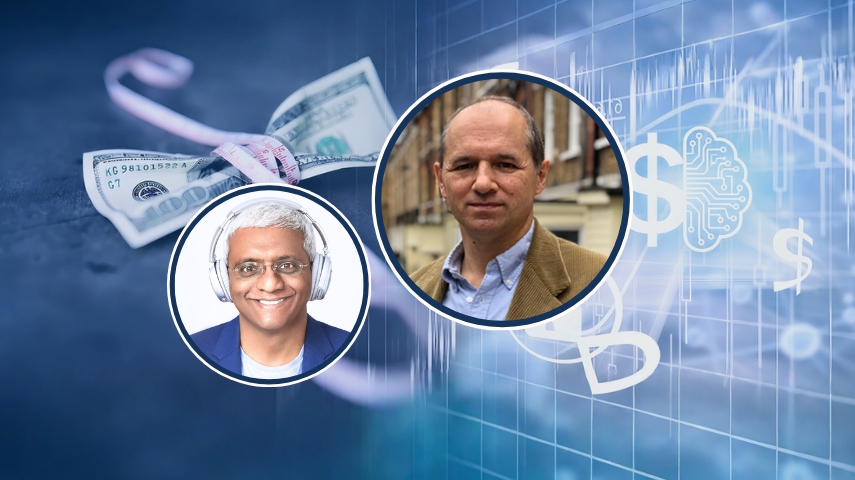
Charles Kelly, who runs the Money Tip Podcast, approaches finance from the perspective of long-term wealth building and personal decision-making, which shaped the direction of this discussion. Rather than focusing on short-term market noise, we explored how global trade dynamics, the future of the US dollar, BRICS, crypto and artificial intelligence intersect to redefine how value is created, stored and transferred.

I shared why I believe the global financial system is not fragmenting, but reorganising itself around new networks, new forms of trust and new expressions of individual agency. From property markets in the Middle East and Africa to the rise of digital assets and AI-enabled businesses, the conversation centred on how individuals and institutions can navigate uncertainty without relying on outdated assumptions.
Here’s what we discussed:
- The future of the US dollar: Why the dollar continues to anchor the global financial system, and how trade dynamics, rather than ideology, are reshaping financial relationships.
- BRICS and alternative systems: Why BRICS is not a coherent alternative currency bloc, and what bilateral trade, swap lines and local settlement actually mean in practice.
- Crypto and digital assets: Why volatility does not invalidate crypto as an asset class, and how network effects shape value in the digital economy.
- The network society: How finance is moving beyond the platform economy towards personalisation, self-custody and direct participation.
- AI and the future of work: Why artificial intelligence is changing the role of intermediaries, compressing organisations and reshaping how wealth can be created.
- Geography and opportunity: How emerging markets, global mobility and policy intent influence where growth and stability are likely to appear next.
The discussion touches on key ideas from my book, The Great Transition, particularly the shift from institution-led finance to user-led networks, and the implications this has for investment strategy, governance and personal agency.
My thanks to Charles Kelly for the wide-ranging questions and for creating space to explore these themes in depth.
Listen to the episode below: